
TIM INFINITY / THERMOFORMING MATERIALS

Materials for Thermoforming & Vacuum Forming

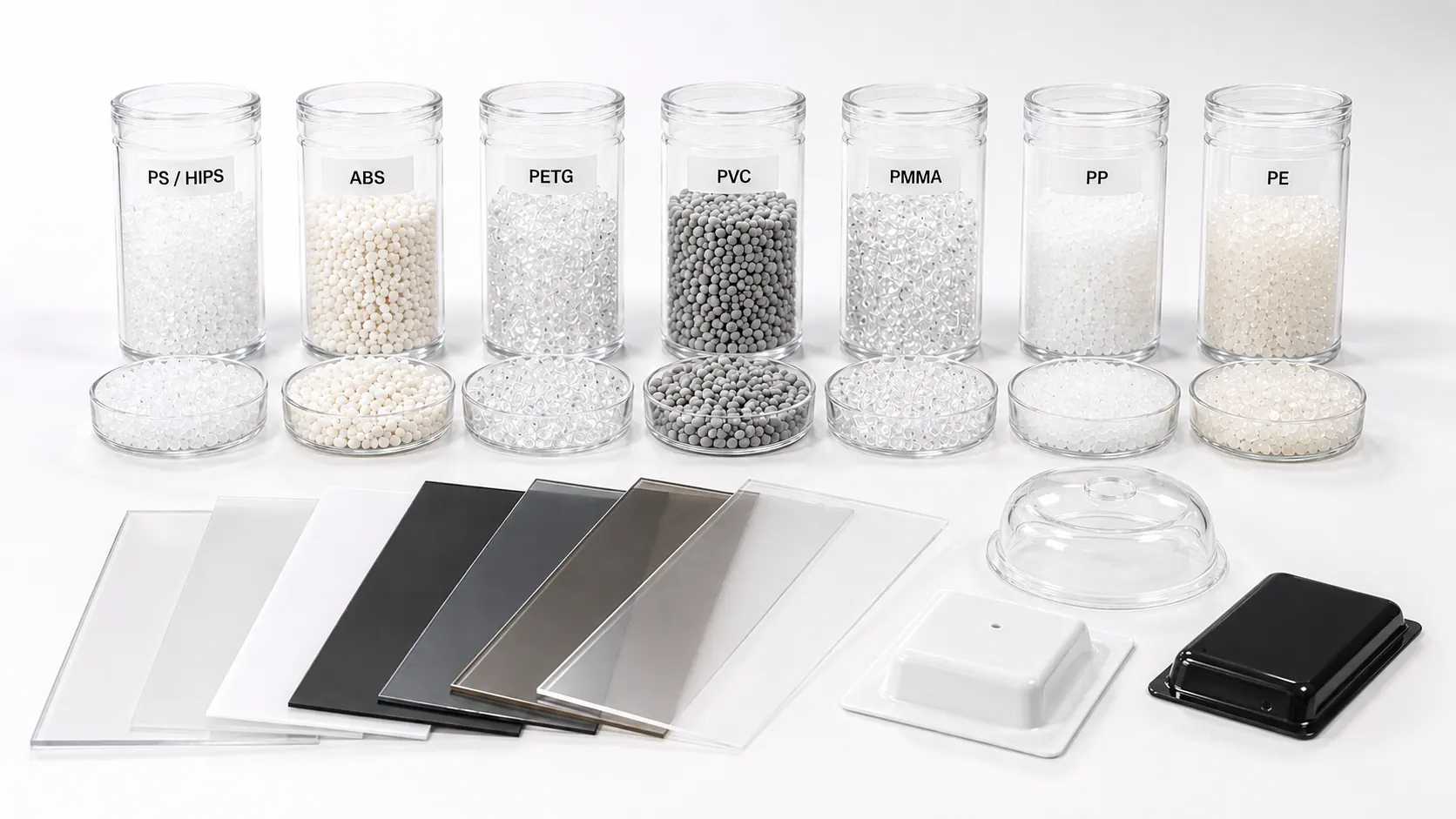
TIM Infinity works with a range of materials for thermoforming and vacuum forming. Selection depends on the product application, geometry, mechanical and visual requirements and conditions of use. The appropriate material is selected according to the requirements of the specific part and the planned manufacturing process.

Thermoplastic sheets and formed plastic parts for thermoforming.

MATERIAL SELECTION

How we select material for a thermoformed part

Correct material selection begins with the requirements of the finished product, not simply with the name of the polymer.

Function and operating conditions

The first step is to define where and how the part will be used and the influences it may be exposed to.

Depending on the product, impact resistance, chemical exposure, moisture, temperature changes and other operating conditions can be important.

Part geometry and draw depth

During thermoforming, the material stretches over the tooling geometry. The starting sheet thickness, draw depth, radii and surface distribution therefore affect thickness distribution in the finished part.

A material that suits a simple shallow part may not be equally suitable for a deeper or more complex geometry.

Mechanical requirements

For housings, covers and technical parts, stiffness, toughness and impact resistance may be important.

The priority depends on the function of the specific product — there is no single material that is best for every type of part.

Final appearance and transparency

For visible parts, surface quality, colour, gloss, texture and level of transparency may all be important.

Where transparency is required, selection is focused on suitable materials such as PETG, transparent PVC grades or PMMA.

Finishing requirements

Material selection also needs to account for operations carried out after thermoforming. Whether the part will be trimmed, drilled, fitted, bonded or joined, painted or otherwise processed is considered because materials differ in their suitability for specific finishing operations.

01

ABS for thermoforming

ABS is a practical material for housings, fascias, covers and other technical plastic parts.

It combines good stiffness, toughness and impact resistance with good thermoforming and secondary-processing characteristics. It can be machined, bonded and painted, which makes it useful where the part requires additional finishing after forming.

housings · fascias · covers · cladding · technical parts

02

PS / HIPS for thermoforming

PS (polystyrene) and HIPS belong to the same broader material family, but they should not be treated as exactly the same solution.

HIPS is a polystyrene material with improved impact resistance. It thermoforms well and can be suitable for subsequent bonding, painting and printing.

Because of their good processability, PS/HIPS can be practical for a range of formed parts, models, prototypes, housings and other products where the technical requirements suit the properties of the material.

03

PETG for thermoforming

PETG is particularly relevant where a transparent thermoformed part is required.

The material combines good optical transparency, impact resistance and good thermoforming properties. Suitability for a specific part is assessed according to geometry, surface requirements and conditions of use. After forming, it can also be mechanically processed.

Possible applications:

  • transparent protective covers;
  • formed transparent fascias;
  • technical transparent elements;
  • advertising and retail elements;
  • parts where visibility through the product is important.

PETG is not treated as a universally best transparent material — the choice between PETG, a suitable transparent PVC grade and PMMA depends on the priorities of the product.

04

PMMA — acrylic / acrylic glass

PMMA is often used where surface appearance, transparency and optical quality are important. It can be fully transparent, translucent or light-transmitting in different colours, and it can also be supplied as an opaque coloured sheet.

The specific PMMA grade is selected according to product application, the required visual effect, geometry and thermoforming requirements.

05

PVC for thermoforming

Suitable PVC grades can be used where stiffness, good chemical resistance and the ability to carry out subsequent processing or joining are required.

With PVC, it is particularly important to select the specific grade according to the intended application because the properties of different formulations can vary considerably.

06

PP — polypropylene

PP is considered for products where low weight, good chemical resistance and very low moisture absorption are important.

For thermoforming, grade, sheet thickness and process conditions need to be correctly matched to part geometry. PP should therefore not be selected only on the basis of chemical resistance or low weight.

technical parts · products exposed to moisture · parts used in more chemically demanding environments

07

PE — polyethylene

PE, including suitable PE-HD grades, can be appropriate where toughness, chemical resistance, low water absorption and good mechanical durability are important.

As with PP, the specific grade and forming conditions need to be matched to the product geometry.

TRANSPARENT MATERIALS

PETG, PVC or PMMA for transparent parts?

PETG

PETG provides good transparency and can be suitable for appropriate transparent thermoformed parts. The choice depends on the geometry and requirements of the specific product.

Transparent PVC

Suitable transparent PVC grades are available. Selection depends on the specific application, material properties and the conditions in which the product will be used. Transparent PVC can be appropriate where, in addition to transparency, specific chemical, surface or functional requirements are important.

PMMA — acrylic / acrylic glass

PMMA is considered where optical appearance and transparency are priorities. Selection compared with PETG and transparent PVC depends on geometry, surface requirements and product application.

THICKNESS & GEOMETRY

Sheet thickness and product geometry

TIM Infinity thermoforms materials in starting thicknesses of 0.1–5 mm within the confirmed technical capabilities.

This figure refers to the thickness of the starting material. During thermoforming, the sheet stretches over the tool, so the thickness of the finished product is not identical in all areas.

The starting thickness is therefore selected according to:

  • part dimensions;
  • draw depth;
  • radii and transitions;
  • surface distribution;
  • required stiffness and function of the finished part.

APPEARANCE & SURFACE

Colour, surface and special material requirements

In addition to the basic polymer type, thermoplastic sheets can differ in colour, surface finish and additional properties of the specific grade.

Depending on the product, surface appearance and texture, transparency, suitability for painting or printing and special characteristics required by the application can all be relevant.

Availability of a specific colour, surface finish or special grade is checked according to the project requirement and material availability.

INFORMATION FOR MATERIAL SELECTION

Defining the right material for a project

The appropriate material depends on the product, its geometry, conditions of use and requirements for appearance and function. The more precise the starting information, the easier it is to assess which material suits the specific project.

Application

Define where and how the product will be used and which basic functional requirements it needs to meet.

Geometry and dimensions

Shape, depth, radii, dimensions and product details influence material selection and starting sheet thickness.

Mechanical requirements

Required stiffness, toughness, impact resistance and other properties depend on the specific application.

Transparency and visual requirements

Where transparency, a particular surface appearance or a specific colour is required, these requirements affect material selection.

Conditions of use

Temperature, contact with other materials, environment and operating method can influence material selection.

Finishing requirements

Painting, cutting, drilling, bonding or other finishing operations should be taken into account when selecting the material.

FAQ

FAQ about thermoforming materials

SEND AN ENQUIRY

Not sure which material is suitable for your part?

Send the basic information about the part, its intended use, dimensions and surface requirements so that we can assess which material is appropriate for the project.

Send an enquiry